Executive summary
GreenBack pays shoppers cash back when they buy groceries with a recognized sustainability certification, such as USDA Organic. The brand funds the reward, and the shopper proves the purchase by snapping a receipt.
We are 1 of 9 finalists in the Innovation Day Collegiate Pitch Showcase and pitch at Innovation Day, part of the 18th Annual Southeast Florida Climate Leadership Summit, on November 4, 2026, with a $150,000 pre-seed ask. GreenBack has not launched yet. Everything below is research, not customer results.
My role
I lead operations, customer research and the product build. The pitch and the poster are team work with my two co-founders. Some background research memos were written with AI assistance.
The problem
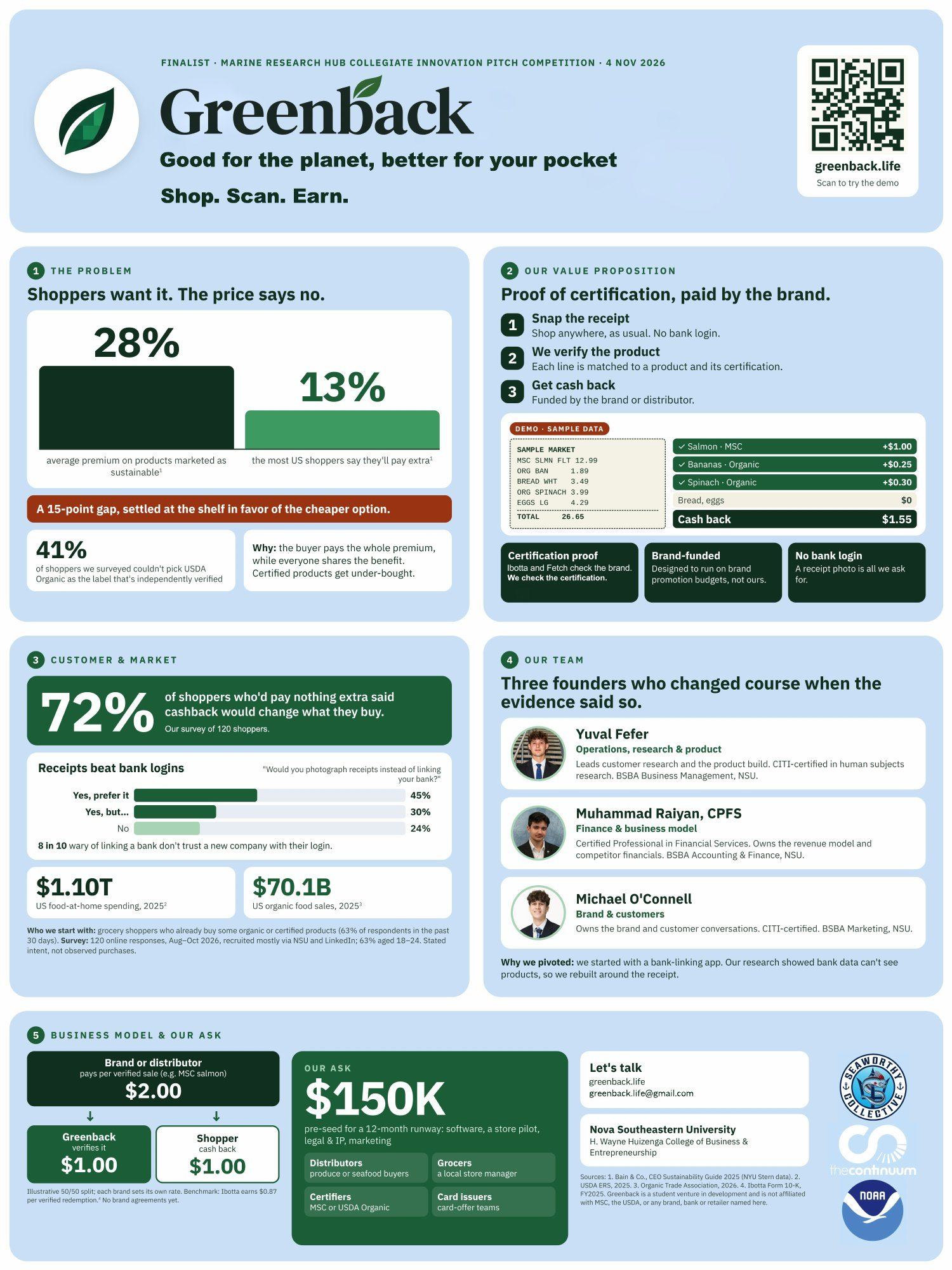
In the US, products marketed as sustainable cost an average of 28% more, while shoppers say they would pay up to 13% more (Bain & Company, 2025, citing NYU Stern data). The gap stops most people at the shelf. Labels do not help much either: in our survey, 41% could not pick out the USDA Organic label.
What we did
- Surveyed 120 shoppers between August and October 2026.
- Started with a bank-card-linked design. 8 in 10 shoppers were wary of linking a bank account, and card data shows the store and the amount but not the products. We moved to receipts.
- Set the model: the brand pays $2.00 per verified sale, split $1 to the shopper and $1 to GreenBack.
- Built the final summit poster and the pitch.
Results and sources
| Figure | What it measures | Source |
|---|---|---|
| 120 | Shoppers surveyed, Aug to Oct 2026 | GreenBack survey |
| 72% | Of shoppers who'd pay nothing extra, the share who said cash back would change what they buy | GreenBack survey |
| 45% · 30% · 24% | Would snap receipts instead of linking a bank: yes · yes, but · no | GreenBack survey |
| 8 in 10 | Wary of linking a bank account | GreenBack survey |
| 41% | Could not pick out the USDA Organic label | GreenBack survey |
| 1 of 9 | Finalists, Innovation Day Collegiate Pitch Showcase | Competition notice |
Survey answers describe what shoppers say they would do. They are not purchases.
Materials
Lessons
Test how people want to prove a purchase before building it. Our first design depended on bank linking; the survey showed most shoppers did not want that, so receipts became the core of the product.