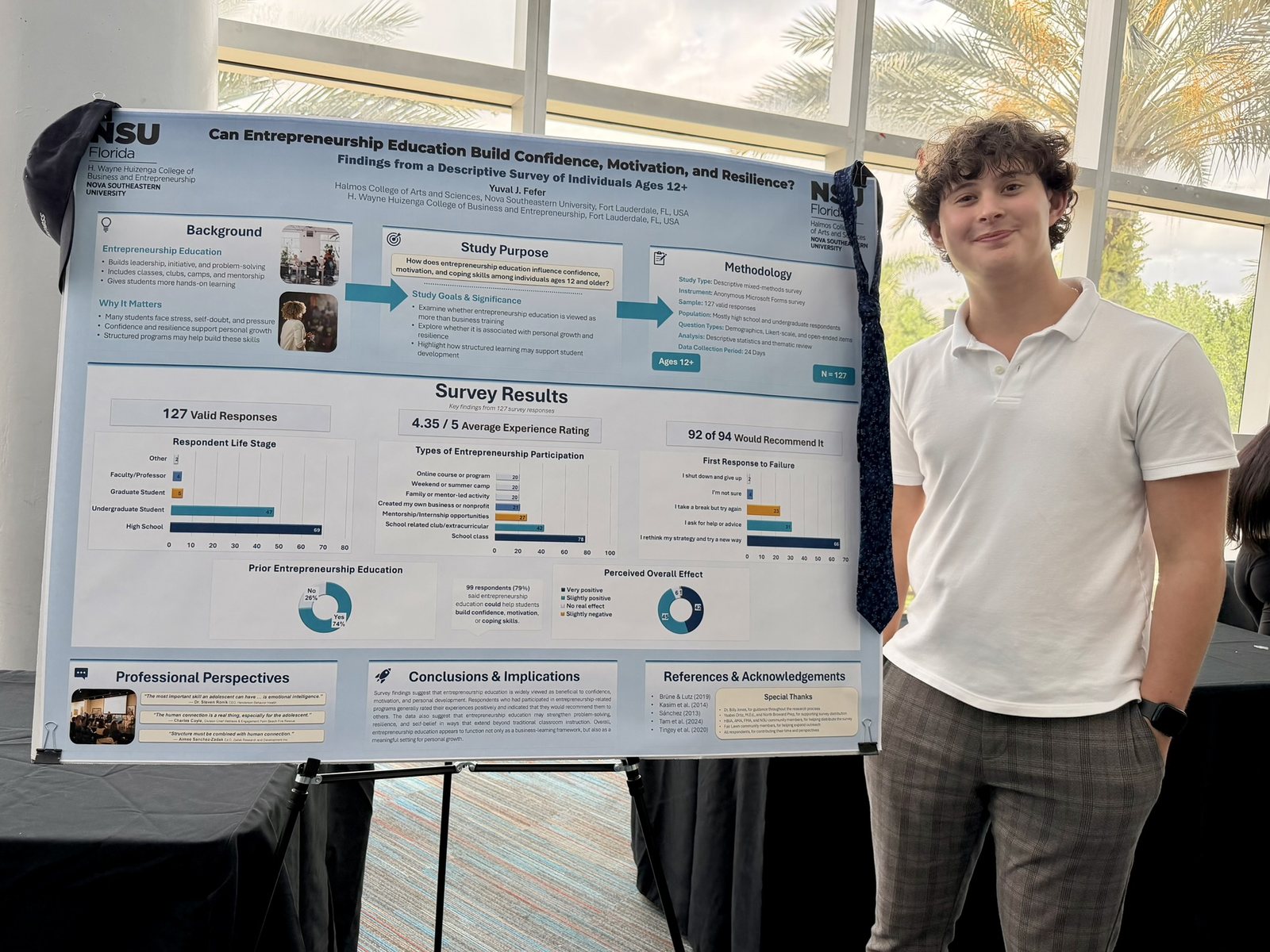
Executive summary
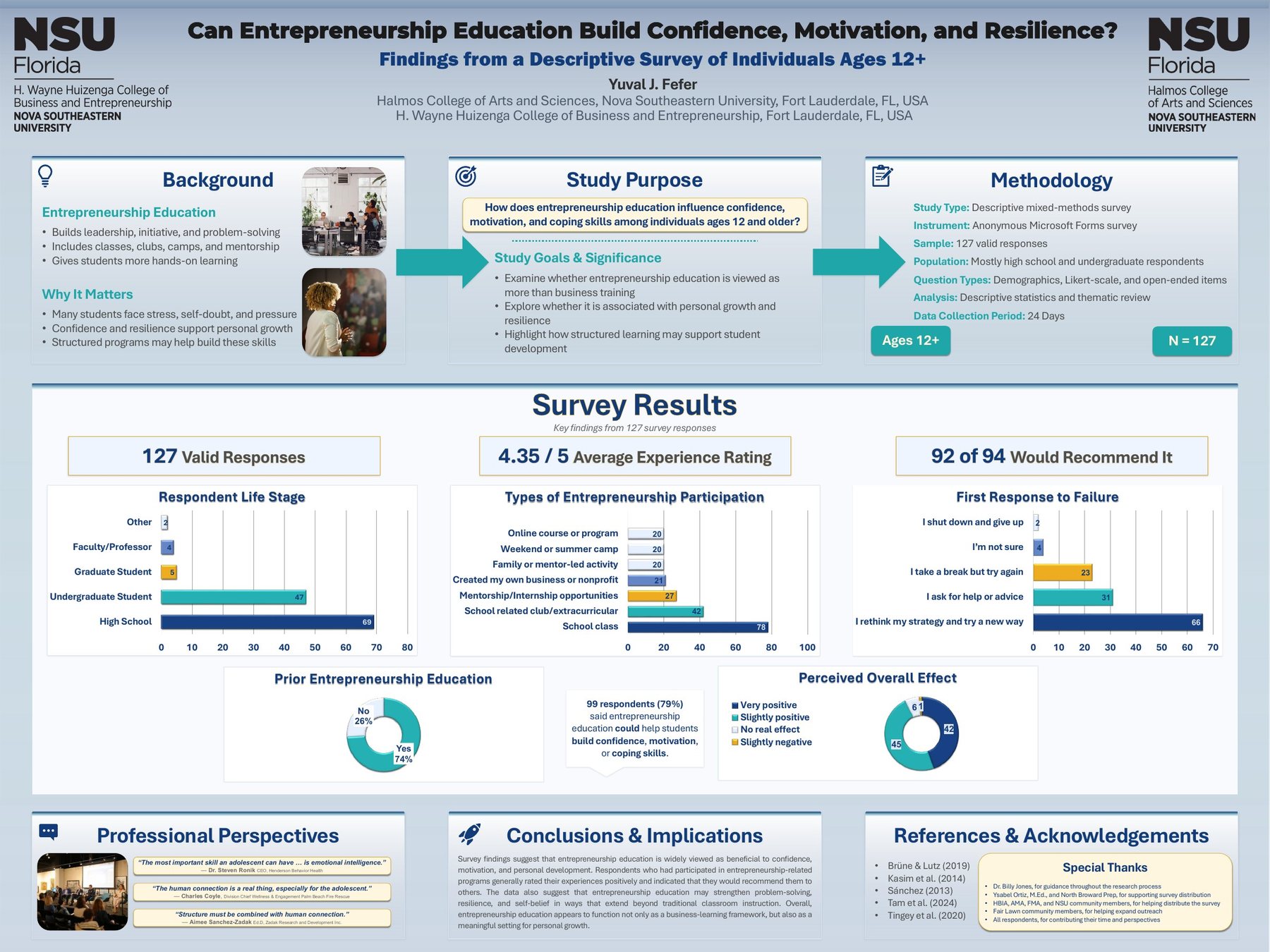
I asked whether people see entrepreneurship education as more than business training. Of 127 respondents, 94 had taken part in some form of it. Most of them rated the experience well and would recommend it, and just over half of everyone surveyed said their first response to failure is to rethink and try a new way.
This is a descriptive survey. It shows how people see their own experience. It cannot show that the programs caused any change.
Research question
How does entrepreneurship education influence confidence, motivation, and coping skills among individuals ages 12 and older?
My role
I chose the topic and the question, built the survey in Microsoft Forms, recruited respondents through schools, campus groups and community networks, and designed the poster. AI tools helped with survey wording, drafting and design feedback.
Methodology
- Design: a descriptive survey with rating, multiple-choice and open-ended questions.
- Respondents: 127 valid responses, ages 12 and up, mostly high school (69) and undergraduate (47) students.
- Recruitment: school, campus, community and personal networks. Not a random sample.
- Analysis: descriptive statistics and a review of themes in the open answers.
Findings
One interpretation: most respondents describe failure as something to work through, not a stopping point. Whether entrepreneurship education produced that habit, or attracts people who already have it, this survey cannot say.
Limitations
- Self-selected sample from my own networks, so it is not representative.
- Everything is self-reported.
- No comparison group and no before-and-after measure, so no cause and effect.
- The questions were written for this study, not taken from a validated scale.
- Most respondents were high school or college students.
- Totals differ by question (94, 126 or 127), so this page shows counts, not percentages.
Materials
Lessons
A survey shows what people believe, not what caused it. If I ran this again, I would add a comparison group and measure the same people before and after a program, so the results could say more than how people feel about it.